
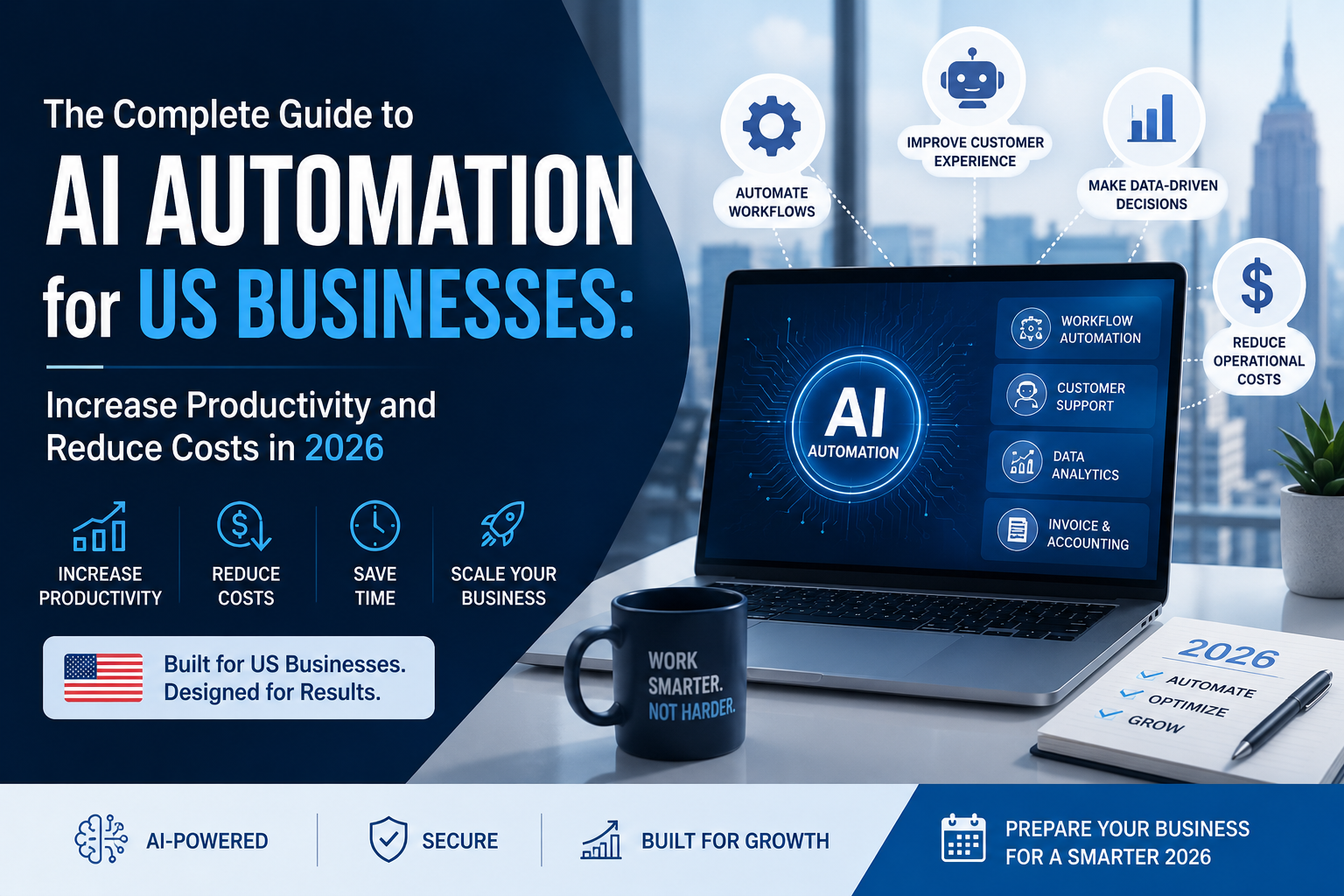
The Complete Guide to AI Automation for US Businesses: Increase Productivity and Reduce Costs in 2026
Artificial Intelligence is no longer a future trend; it has become a business necessity. Across the United States, organizations of every size are adopting AI automation to streamline operations, improve customer experiences, reduce costs, and increase productivity. From startups and e-commerce brands to healthcare providers and enterprise organizations, companies are discovering that intelligent automation can transform how work gets done.
As competition intensifies in 2026, businesses that continue relying solely on manual workflows risk slower growth and higher operational expenses. This guide explores everything US businesses need to know about business automation, including its benefits, use cases, implementation strategies, and how AI can create long-term operational efficiency.
What Is AI Automation?
AI automation refers to the use of artificial intelligence technologies to automate repetitive processes, analyze data, make predictions, and support business decision-making with minimal human intervention.
Traditional automation follows fixed rules and workflows. AI-powered systems go further by learning patterns, adapting to new information, and improving outcomes over time.
Examples of AI automation include:
- AI chatbots for customer support
- Automated email responses
- Predictive analytics tools
- Intelligent workflow automation
- AI-driven lead scoring
- Document processing systems
- Smart inventory management
- Automated marketing campaigns
Businesses across the United States are increasingly investing in AI because it helps teams operate faster and more efficiently.
Why AI Automation Matters for US Businesses in 2026
The US market continues to become more competitive and digitally driven. Businesses face increasing pressure to:
- Reduce operating costs
- Improve customer experiences
- Increase employee productivity
- Process larger volumes of data
- Respond faster to market changes
AI automation addresses these challenges by creating more efficient business operations.
According to industry trends, companies implementing intelligent automation are seeing measurable improvements in workflow efficiency, customer service, and cost savings.
Key business goals AI supports include:
✔ Faster operations
✔ Lower overhead costs
✔ Better decision-making
✔ Improved customer satisfaction
✔ Higher scalability
✔ Reduced human error
Top Benefits of AI Automation
1. Increased Productivity
One of the biggest advantages of AI is its ability to automate repetitive tasks.
Employees often spend hours on activities like:
- Data entry
- Scheduling
- Customer inquiries
- Reporting
- Administrative workflows
AI systems can perform these tasks continuously without fatigue.
As a result:
- Teams focus on strategic work
- Employees become more productive
- Businesses operate more efficiently
Organizations using business automation solutions frequently experience significant workflow improvements.
2. Lower Operational Costs
Reducing expenses remains a priority for most businesses.
AI helps decrease costs by:
- Minimizing manual labor requirements
- Reducing errors
- Eliminating process inefficiencies
- Lowering customer support expenses
- Improving resource allocation
Rather than increasing headcount, businesses can scale operations using automation technology.
For growing US companies, this creates long-term cost advantages.
3. Better Customer Experiences
Customer expectations continue rising.
Consumers expect:
- Fast support
- Personalized experiences
- 24/7 assistance
- Immediate responses
AI automation allows companies to deliver these experiences through:
AI Chatbots
AI-powered support systems can:
- Answer common questions
- Route tickets
- Schedule appointments
- Process requests instantly
Businesses can provide around-the-clock support without expanding support teams.
4. Data-Driven Decision Making
Modern organizations generate enormous amounts of data.
AI systems analyze information quickly and identify:
- Customer behavior patterns
- Sales trends
- Performance metrics
- Business opportunities
Instead of relying on assumptions, leaders gain actionable insights.
This improves business planning and operational efficiency.
Industries Using AI Automation in the US
AI is impacting nearly every industry.
Healthcare
Healthcare providers use AI for:
- Appointment scheduling
- Medical record analysis
- Patient communication
- Administrative automation
E-Commerce
Online stores use AI for:
- Personalized product recommendations
- Inventory forecasting
- customer support automation
- abandoned cart recovery
Financial Services
Banks and financial companies use AI for:
- Fraud detection
- risk assessment
- customer service
- automated reporting
Manufacturing
Manufacturers automate:
- Production monitoring
- quality control
- predictive maintenance
- supply chain management
Marketing Agencies
Marketing teams automate:
- Lead qualification
- campaign optimization
- email personalization
- content recommendations
Common AI Automation Use Cases
Businesses often start with small automation initiatives before scaling.
Popular use cases include:
Customer Support Automation
AI tools can:
- answer FAQs
- reduce ticket volume
- route customer requests
- provide instant support
Sales Process Automation
AI assists sales teams by:
- scoring leads
- predicting conversions
- automating follow-ups
- improving CRM management
Marketing Automation
AI can:
- personalize campaigns
- optimize advertisements
- segment audiences
- generate insights
Document Processing
AI extracts and processes information from:
- invoices
- contracts
- forms
- reports
This reduces manual administrative work.
How to Implement AI Automation Successfully
Many organizations fail because they attempt to automate everything at once.
A structured approach produces better results.
Step 1: Identify Repetitive Processes
Begin by identifying tasks that:
- consume time
- require manual effort
- create bottlenecks
Prioritize areas with measurable impact.
Step 2: Define Business Goals
Ask:
What outcomes are you trying to achieve?
Examples:
- reduce support costs
- improve response times
- increase sales productivity
- automate workflows
Clear objectives help measure success.
Step 3: Choose the Right Technology
Not every AI solution fits every business.
Consider:
- integration capabilities
- scalability
- security
- usability
- support requirements
Step 4: Start Small
Begin with pilot projects.
Examples:
- chatbot implementation
- workflow automation
- AI reporting tools
Scale after validating results.
Step 5: Measure Performance
Track metrics such as:
- time saved
- operating costs reduced
- conversion rates
- productivity improvements
- customer satisfaction scores
Continuous optimization creates better long-term outcomes.
Challenges Businesses Should Consider
While AI automation offers significant advantages, businesses should plan for challenges.
Common concerns include:
Data privacy
Organizations must protect customer information and maintain compliance requirements.
Integration complexity
Legacy systems can create implementation difficulties.
Employee adoption
Teams may resist change without proper training and communication.
Initial investment
Some AI solutions require upfront costs before long-term savings appear.
A strategic implementation approach reduces these risks.
The Future of AI Automation in 2026 and Beyond
AI adoption continues to accelerate across the United States.
Future trends include:
- Hyperautomation
- AI agents
- predictive decision systems
- autonomous workflows
- advanced personalization
- AI-powered business intelligence
Organizations that embrace automation early may gain significant competitive advantages.
Businesses waiting too long risk falling behind faster-moving competitors.
Final Thoughts
AI automation is changing how US businesses operate. Companies no longer view automation as an optional technology investment; it has become a strategic growth initiative.
By reducing operational costs, improving productivity, and enhancing customer experiences, AI enables organizations to build more efficient and scalable operations.
Whether your company operates in healthcare, e-commerce, finance, or digital services, implementing AI automation can help prepare your organization for the future.
The key is starting with a clear strategy, selecting the right tools, and focusing on measurable business outcomes.
Businesses that successfully adopt AI in 2026 will likely define the next generation of operational excellence and digital transformation.

